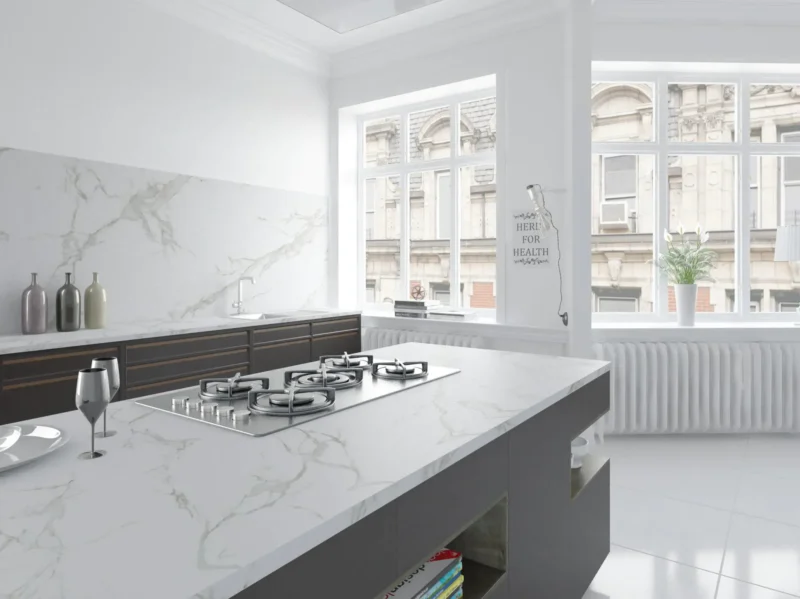
From Stone Slab to Finished Kitchen: How Chandler Stoneworks Creates Bespoke Worktops
Creating a bespoke stone worktop involves far more than cutting a slab to size. Chandler Stoneworks takes each project through material selection, detailed templating, workshop fabrication, finishing and installation, with every cut-out, edge, join and section planned around the kitchen and the chosen material. Installation normally follows around 7 to 10 days after templating.
What makes a stone worktop genuinely bespoke?
No two kitchens are exactly the same, and no two natural stone slabs are exactly the same either. A genuinely bespoke worktop has to respond to both. It is made to the dimensions of the room, but also to the practical details that make the kitchen work day to day.
That can include:
- sink type and position
- hob cut-outs and tap holes
- draining grooves
- worktop thickness and edge profile
- upstands, splashbacks and window cills
- island size, overhangs and structural support
- joins, access and the way sections will be carried into the property
With natural materials such as granite, marble and quartzite, the pattern within the slab introduces another layer of judgement. Veining, movement and colour variation can influence where individual worktop sections are positioned and how the finished kitchen looks as a whole.
1. Choosing the material and defining the design
The process starts before anything is templated or cut. Customers need to choose a surface that works visually and practically for their kitchen. Our kitchen worktop materials include natural stone and engineered surfaces, each with different characteristics, colours and levels of variation.
For strongly patterned natural stone, looking at a small sample is not always enough. As we explain in our guide to selecting stone for a kitchen, viewing the material at a larger scale gives a much better sense of its overall colour, movement and character.
This is also the stage to settle the details that will affect fabrication. Sink style, hob size, tap positions, upstands, splashbacks and the chosen edge finish all need to be understood before the final worktops are produced. Customers can also explore our range of worktop edge profiles to see how a relatively small design decision can change the appearance of the finished surface.
2. Templating the kitchen accurately
Templating is the point where the kitchen moves from a design on paper to exact working dimensions. Before we template, the base units need to be fitted securely and the layout needs to be final. The sink, hob and other relevant fittings should also be available so their positions and openings can be accounted for.
Before templating, it is sensible to check that:
- all base units are installed and secure
- the sink and hob are available
- appliance and fitting positions are confirmed
- worktop details such as edges and upstands have been agreed
- someone is available to confirm any final decisions
- the cabinetry will not be altered after the template is taken
Our templating and fitting process explains the practical steps in more detail. Getting this stage right matters because the fabrication that follows is based on the kitchen as it exists at the time of templating.
3. Turning the template into a fabrication plan
A template tells us the size and shape required, but there are still important decisions to make before the slab becomes a finished worktop. We need to consider how the different sections will be arranged, where joins should sit, how cut-outs fit into the design and how the finished pieces will be transported and installed.
Natural stone can make this stage particularly important because the slab itself may influence the best solution. The aim is not simply to fit every component onto the material. It is to use the slab intelligently while producing sections that can be fabricated, moved and fitted safely.
A good example is our Bianco Eclipse leathered quartzite kitchen project. The large island needed to be produced in three sections. The solution had to take account of the detail within the quartzite as well as the practical restrictions involved in getting the finished stone into position.
4. Cutting, shaping and finishing the worktop in our workshop
Once the fabrication plan is agreed, the work moves into our workshop near Arundel. This is where the stone is cut, shaped, polished and finished to match the template and specification.
Depending on the project, workshop fabrication can include:
- cutting individual worktop sections to shape
- creating sink and hob openings
- forming tap holes and other required cut-outs
- shaping and polishing exposed edges
- preparing joins between sections
- creating more specialised mitred or built-up details where the design requires them
This is one of the stages where experience is most visible. A straightforward run of worktop and a large feature island may use the same material, but the fabrication challenge can be very different.
Our Sensa Creative Design project is a useful example. The design used 30 mm granite and required mitred sections, concealed steel support and undercloaking to achieve the intended peninsula detail. Some elements were prepared in the workshop, while others needed careful finishing during installation.
5. Checking the details before installation
Before completed sections leave the workshop, the important details need to match the agreed specification. The practical side matters too. Large pieces of stone are heavy and access through doors, hallways and around corners can affect how a design is divided into sections.
This is why the finished result depends on more than accurate cutting. The worktop has to be designed with the real property, the installation route and the final kitchen in mind from the outset.
6. Installing the finished worktops
For a typical project, installation normally takes place around 7 to 10 days after templating. The fitting itself generally takes around 2 to 4 hours, although the exact time depends on the size and complexity of the kitchen.
During installation, the fabricated sections are positioned, joins are completed and the worktops are checked in the kitchen they were made for. Plumbing, gas and electrical connections are handled separately by the appropriate trades, so these should be planned around the worktop installation where necessary.
Once the worktops are fitted, the customer can see the full effect of the decisions made earlier in the process: the way the slab pattern sits in the room, the relationship between sections, the edge detail, the cut-outs and the overall balance of the finished kitchen.
Sometimes the stone dictates the solution
Bespoke stone fabrication is not a production line where every kitchen follows exactly the same formula. Natural materials, unusual layouts and real buildings can introduce constraints that are not obvious from an initial drawing.
That is where specialist judgement becomes important. On one project, the character of a quartzite slab and access restrictions may determine how an island is divided. On another, a design may need hidden support or more complex fabrication to achieve the appearance the customer wants.
The best result comes from considering those factors together, rather than treating templating, fabrication and installation as separate jobs. Each decision affects the next stage.
Planning a bespoke worktop for your kitchen?
If you are planning a new kitchen, you do not need to have every stonework detail resolved before speaking to us. A kitchen plan or sketch, an idea of the material you prefer and the key features you want to include are enough to start the conversation.
You can visit our showroom near Arundel to explore materials and discuss the practical options, or request a quote for your worktops and we can help turn the initial design into a finished surface made specifically for your kitchen.